
- New
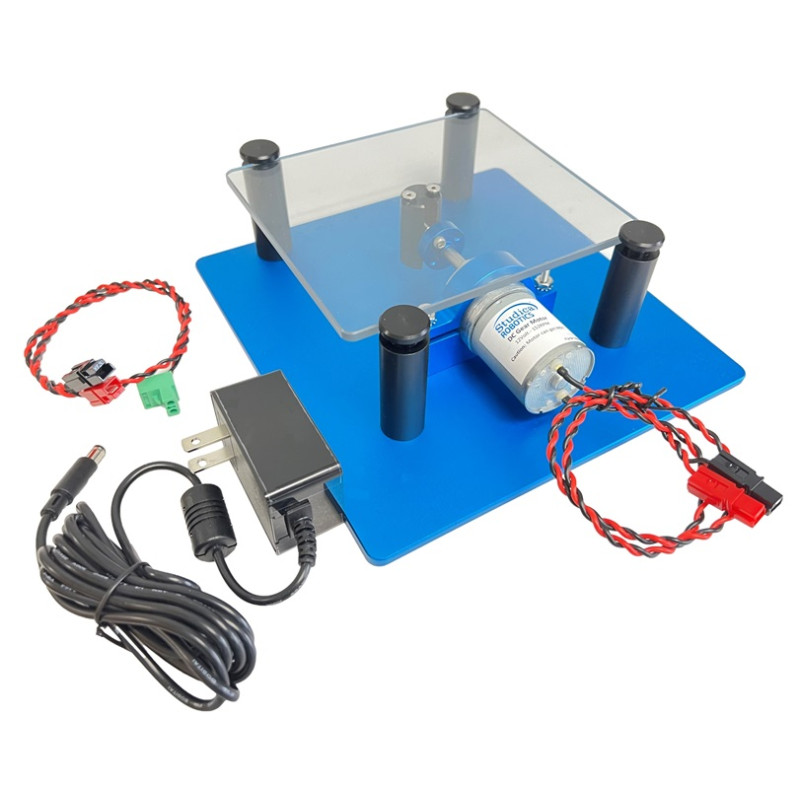

The Studica Robotics Earthquake Shake Table is used in the STEM classroom to simulate the seismic shaking of structures, vibration research, stability/rigidity testing, resonant frequencies and sensor measurements.
The Studica Robotics Earthquake Shake Table is used for data-driven design of safer buildings. Students create their design of a building for earthquake resistance and conduct experiments to test building modifications. Analysis of the data sets are used to develop a final design considering the building height, safety and associated costs.
Please note : The shake table can be used in conjunction with a NI myDAQ (or equivalent) and the former Pitsco myQuake circuit board or other similar instruments. You can also bypass the myDAQ and circuit board with the utilization of a separate DC Motor, Barrel Connectors and a Video Analysis application (not included).
Dimensions: Top plate - 5.75" x 5", Bottom plate - 7.75" x 8", Height - 2.5"
Items needed:
Earthquake Engineering Education:
Hands-On Learning: Educational institutions use earthquake simulation tables to provide students with hands-on experience in understanding the principles of earthquake engineering. This practical exposure helps students grasp complex concepts related to structural dynamics.
Experimentation: Students can conduct experiments on small-scale models to observe how various factors, such as building materials or structural configurations, impact a structure's response to seismic activity.
Structural Testing and Research:
Material Response: Engineers use earthquake simulation tables to test how different materials and structures respond to seismic forces. This helps in designing buildings and infrastructure that can withstand earthquakes.
Structural Dynamics: Researchers study the dynamic behavior of structures under simulated earthquake conditions. This includes analyzing vibrations, deformations, and modes of failure to improve earthquake-resistant designs.
Design Verification:
Prototyping: Engineers and architects use earthquake simulation tables during the prototyping phase of building design to verify the effectiveness of earthquake-resistant features before construction begins.
Innovative Solutions: Researchers and designers can experiment with new and innovative solutions to enhance seismic resilience in structures.
Emergency Response Planning:
Scenario Testing: Emergency response agencies use earthquake simulation tables to simulate various seismic scenarios. This helps them plan and prepare for potential earthquake events, improving their response capabilities.
Evacuation Planning: Simulated earthquake scenarios allow city planners and emergency responders to evaluate and refine evacuation plans for areas prone to seismic activity.
Equipment Testing:
Validation of Equipment: Critical equipment, such as medical devices or laboratory instruments, may need to be tested for their ability to function during and after an earthquake. Simulation tables provide a controlled environment for such testing.
Quality Assurance: Manufacturers of earthquake-resistant equipment use simulation tables to ensure that their products meet safety standards and can withstand seismic forces.

The Studica Robotics Earthquake Shake Table is used in the STEM classroom to simulate the seismic shaking of structures, vibration research, stability/rigidity testing, resonant frequencies and sensor measurements.